The work jacket or worker's jacket is now the new piece of clothing that is in the news for men. The famous "blue collar" is assiduously worn by the "white collar" as a casual and stylish jacket. What is its history? Why is it back in the spotlight? How to wear this iconic piece? All the answers are in this article.
Its history
The work jacket was created in the 19th century for manual workers, craftsmen, painters, carpenters.... At the end of the 19th century, and at the time of industrialization, companies took it over and provided it to all their workers, in association with its pants called "largeot".

The workers take care of it, mending it to make it last. With time, the unions obtained that the companies take charge of their maintenance. In post-war French society, the work jacket represented hard work, emblematic of the working class.
Some workers, reluctant to the idea of belonging to a social category, refused to wear blue overalls and came to the factory with their own clothes.
The qualities of the work jacket
The work jacket is a robust garment that protects against the dirt caused by the work at the line. It warms up and protects from excessive heat sources. Functional, it can store tools in its many pockets, without being cumbersome thanks to its short cut. It standardizes the workers who are all on the same level. In the factories this jacket is often blue, hence the famous expression "the blue work". It is a jacket that is easily washed.
The fabric
The fabric of the work jacket is made from cotton. It can be made of moleskin, a thick cotton, tightly woven, and covered with a soft coating and varnish. It is a very strong fabric that has a shaved velvet appearance, soft to the touch like a moleskin skin.
Moleskin is one of the few fabrics that become more beautiful over time, it softens with washing and use. The cotton used is between 300g/m2 and 500g/m2, four times the thickness of a poplin shirt. It is an ideal fabric for mid-season weather, its thick fabric keeps warm on cool evenings.
There are also work jackets made of drill: a cotton fabric less thick than moleskine and more affordable. The drill has grooves that are characteristic of it. Drill jackets are very popular today.

The colors
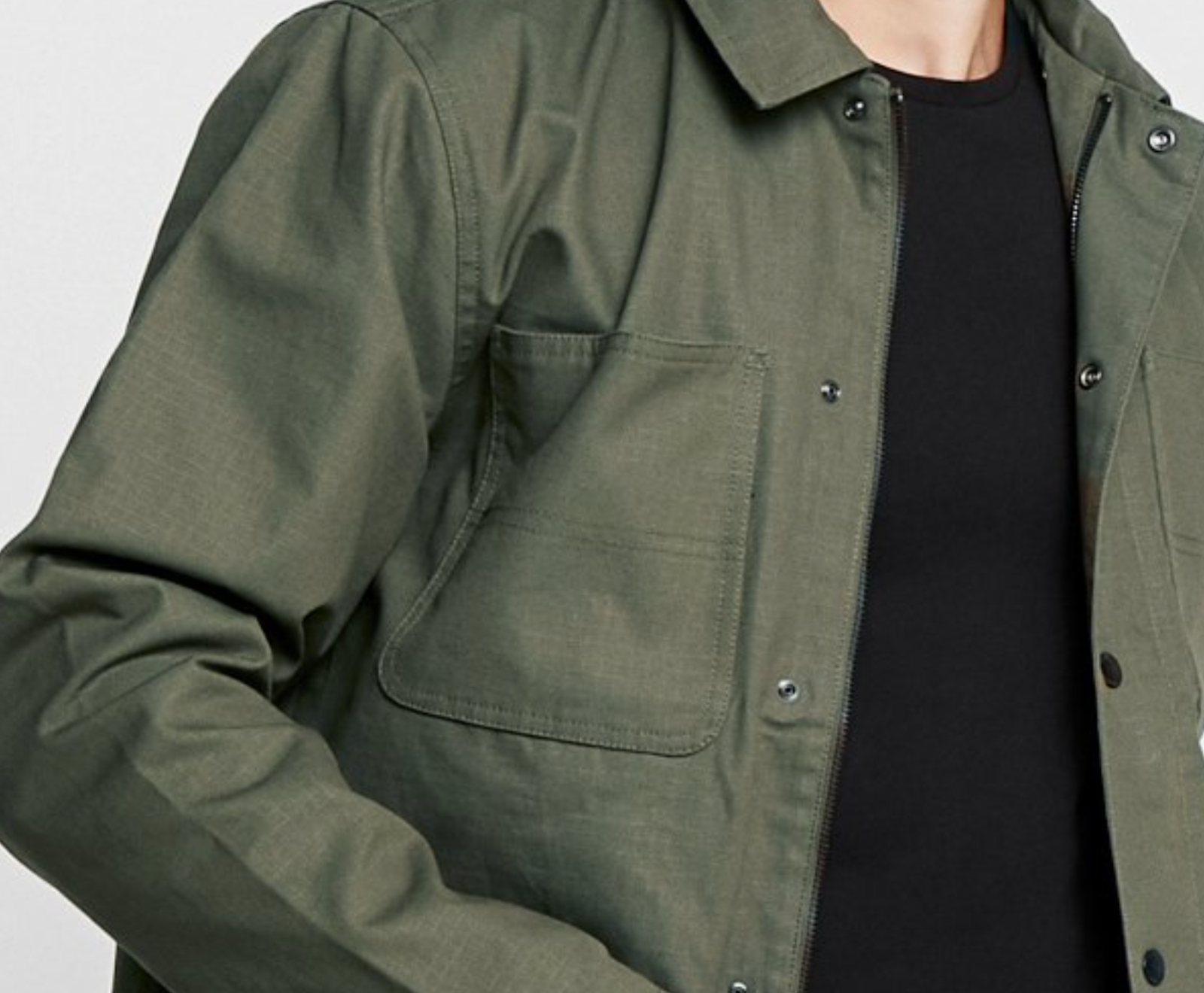
In the past, each trade had its own colors: white for the painters, black for the carpenters, and electric blue "Bugatti" for the workers.
Today we found the work jacket in many colors: black, brick, khaki, off-white ...

Today's trend
The work jacket is part of the workwear trend that has been making a comeback since 2008, partly due to the economic crisis. Now we buy quality and durable clothes, against the current of disposable fashion. We also revisit retro clothing, full of history. The work jacket is an expensive garment because of the quality of its fabric and its finishes. All the major brands have appropriated the workwear style and offer a whole set from jeans, to shirts, jackets and leather gloves.
How to wear it?
The purists of the workwear trend will turn to the full range. For the general public, a work jacket is easily worn with all types of outfits. We choose it in sober colors like beige, black, navy blue, khaki, duck green or even brick. We associate it with jeans and a tee-shirt in the summer, a sweatshirt in the fall for a casual style.

https://www.champdemanoeuvres.com/boutique/homme/vestes-de-travail/veste-de-travail-moleskine-sable/
For a more elegant look it is worn with a white or light blue shirt and a chino. You can opt for a Mao collar shirt to avoid the double collar effect with the work jacket.
The brands
We distinguish the traditional brands born at the beginning of the XXth century, which perpetuate the French cultural heritage and the current brands which emphasize the trend of Workwear.
Among the traditional brands we can note:
-
Le Laboureur: a brand created in 1956 that makes workwear with traditional techniques. Prices between 80 and 120 euros

-
Vetra: or the contraction of "clothing" and "work", a family business created in 1927. French manufacture. Price 120 to 250 euros.

https://www.vetra.fr/en/
-
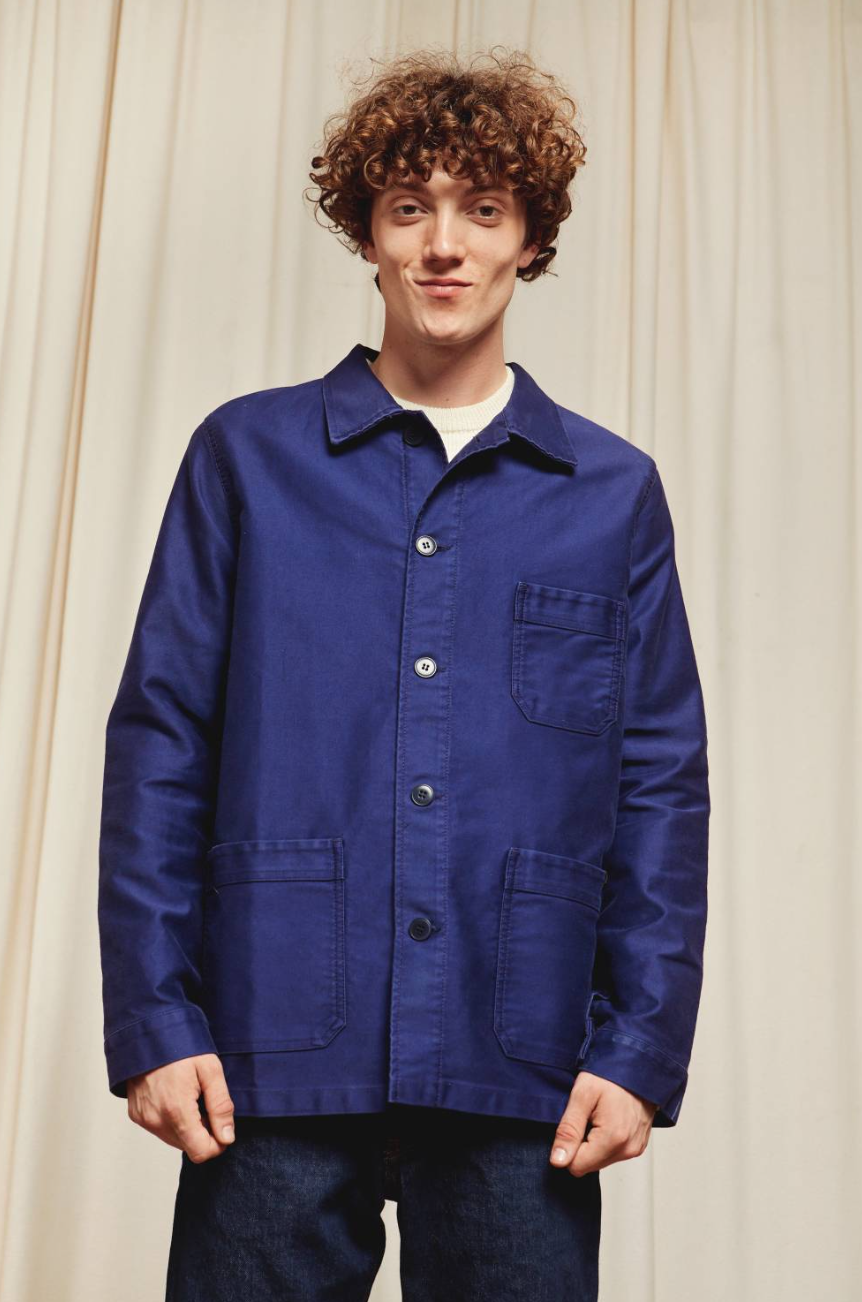
Le Mont Saint Michel: a brand created in 1913 which is now oriented on the Workwear trend. Price: 225 euros
https://lemontsaintmichel.fr/fr/veste-de-travail-80
-
Champ de Manoeuvres: a more recent brand, born in 2015, which is strongly inspired by the Workwear movement in its collections. Price 80 to 125 euros.

https://champdemanoeuvres.com/en
The work jacket is therefore durable over time, easy to wear and now has a modern and distinguished style. Its four large rectangular pockets, one inside and three outside, make it very practical for storing phones, wallets and IDs. It is not lined. It has between four and six buttons to close it up to the collar. This one is a French collar called "col chevalière", that is to say a collar which closes on the neck, contrary to the collar with English lapel open on the neck.
The French work jacket can be compared to the American denim jacket. The raw denim was indeed worn by American workers. Nevertheless the denim jacket conveys a rebellious image, unlike the work jacket which keeps a simpler and more elegant style.